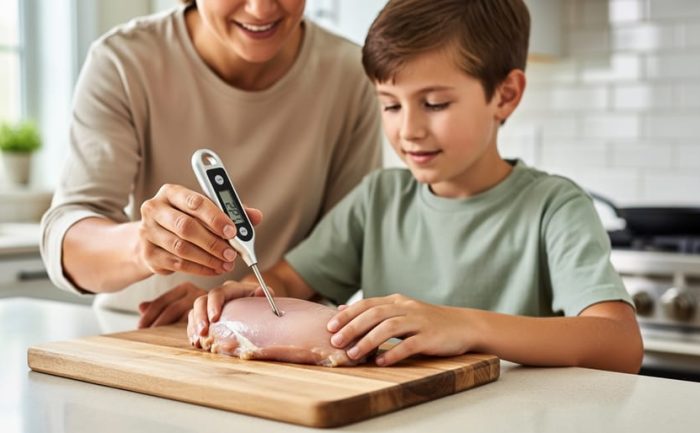
A parent helps a child use an instant-read thermometer to check doneness of a chicken breast on a cutting board in a home kitchen.

Teaching Kids the Right Cooking Temp for Chicken: Why 165°F Matters

Last Tuesday, my neighbor Sarah called me in a panic. Her nine-year-old had just helped prepare chicken for the first time, and she realized she’d never actually taught him the proper cooking temperature. “I just assumed he knew,” she told me, “but when I asked him how to tell if chicken is done, he said ‘when it looks white.’”
Here’s what every parent and educator needs to know: chicken must reach an internal temperature of 165°F to be safe to eat. This single number could be the most important kitchen safety fact you teach a child this year.
Teaching children the correct cooking …
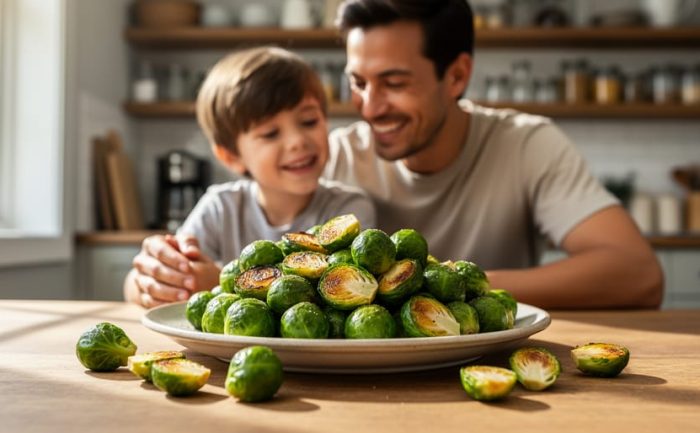
A parent serves roasted Brussels sprouts to a child at a kitchen table while they share a moment of healthy eating and curiosity.

Brussels Sprouts Nutrition Facts: Why This Tiny Vegetable Packs More Power Than You Think

When eight-year-old Maya pushed away her plate at Lincoln Elementary’s cafeteria last fall, she didn’t realize those tiny green spheres contained more vitamin C than an orange. Her teacher, Mrs. Rodriguez, knew something most parents are just discovering: Brussels sprouts pack an extraordinary nutritional punch that can transform children’s health, if only we can get past the reputation problem.
Each half-cup serving of cooked Brussels sprouts delivers 48 milligrams of vitamin C (that’s 80% of a child’s daily needs), 109 micrograms of vitamin K, and a hefty dose of fiber. These miniature cabbages …