 Amanda Waller
Last Tuesday, my neighbor Sarah called me in a panic. Her nine-year-old had just helped prepare chicken for the first time, and she realized she’d never actually taught him the proper cooking temperature. “I just assumed he knew,” she told me, “but when I asked him how to tell if chicken is done, he said ‘when it looks white.'”
Here’s what every parent and educator needs to know: chicken must reach an internal temperature of 165°F to be safe to eat. This single number could be the most important kitchen safety fact you teach a child this year.
Teaching children the correct cooking temp for chicken isn’t about creating fear around food preparation. It’s about building confidence and competence in the kitchen. When kids understand why temperature matters and how to check it properly, they gain a lifelong skill that protects their health and the health of others they’ll cook for someday.
The good news? This critical knowledge is surprisingly simple to teach, even to younger children. You don’t need fancy equipment or complicated lessons. A basic instant-read thermometer and a few memorable demonstrations can make this lesson stick better than any cautionary tale about foodborne illness ever could.
Whether you’re a parent preparing your child for independent cooking or an educator incorporating practical life skills into your curriculum, making temperature safety engaging and memorable transforms a technical requirement into an empowering learning moment. The students who grasp this concept early become the confident home cooks who never second-guess whether their dinner is safe to serve.
Why 165°F Isn’t Just a Number, It’s a Safety Shield
When you cut into a chicken breast and see clear juices running out instead of pink, it’s tempting to think dinner is ready. Many of us grew up watching parents or grandparents use this visual check, assuming golden-brown skin or white meat meant safe eating. But here’s the truth that might surprise you: your eyes can’t see bacteria, and neither can mine.
Chicken needs to reach an internal temperature of 165°F because that’s the point where harmful bacteria like Salmonella and Campylobacter are destroyed. These bacteria live naturally on raw poultry, and they’re invisible. A piece of chicken can look perfectly cooked on the outside, appear white throughout, and still harbor bacteria in cooler spots that haven’t reached the safe zone. The color of the meat or juices tells you about myoglobin proteins breaking down, not about whether dangerous microorganisms have been eliminated.
This is why food safety protocols require using a thermometer rather than relying on guesswork. Think of 165°F as a scientifically proven safety shield. Below that temperature, you’re rolling the dice. At exactly 165°F and above, the bacteria are gone, and your family can eat with confidence. It’s not about being overly cautious or following arbitrary rules. This number comes from decades of research into exactly what temperature makes food safe to consume.
When we teach our children to check the cooking temp for chicken with a thermometer, we’re giving them a skill that protects them for life. We’re showing them that good cooking isn’t just about taste or appearance. It’s about understanding what’s happening inside the food, where it really counts. That small act of inserting a thermometer and waiting for the reading becomes their shield against foodborne illness, transforming an invisible threat into a visible, manageable checkpoint.
Making Food Thermometers Kid-Friendly: A Learning Opportunity
Where to Place the Thermometer (And Why It Matters)
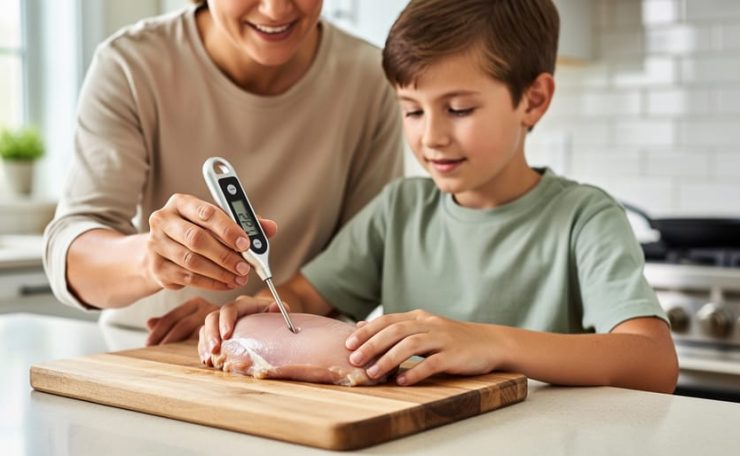
Think of a chicken breast like a mountain. The thickest part is the peak, and that’s where we need to check the temperature. Why? Heat takes longer to reach the center of thick meat, so if the middle hits 165°F, you know the thinner edges are definitely safe too.
Here’s what kids need to learn about proper thermometer placement:
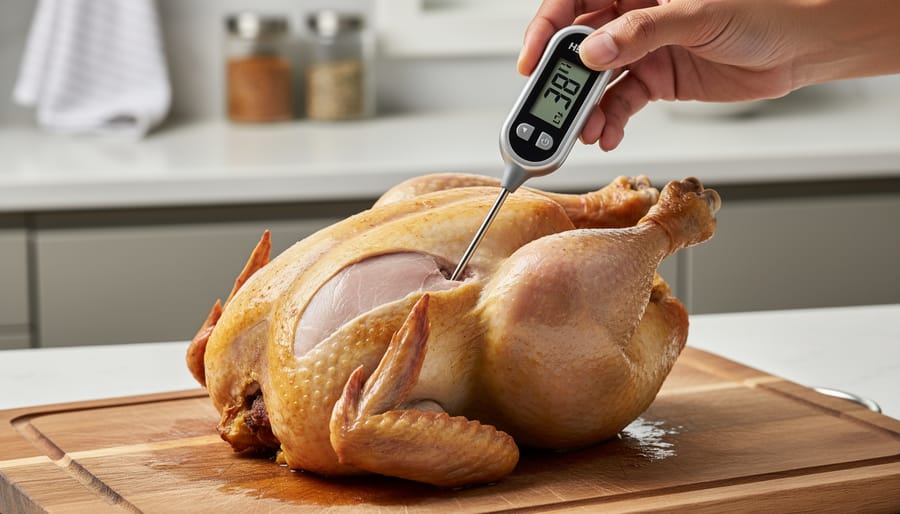
- Push the thermometer into the thickest part of the chicken, which is usually the center of the breast or thigh
- Stay away from bones, which heat up faster than meat and give false high readings
- Avoid fatty areas and gristle, which also conduct heat differently than muscle
- For thin chicken pieces like cutlets, slide the thermometer in from the side until it reaches the middle
- Check two or three different spots on larger pieces to make sure the whole thing is cooked through
You can explain it to younger children by comparing the thermometer to a treasure hunter’s probe. It needs to dig deep into the “meat mountain” to find the coolest spot hiding inside. If that coldest center reaches 165°F, every other part is safe.
For irregularly shaped pieces or whole chicken parts, multiple checks matter because one thick section might lag behind thinner areas. The thermometer should slide in smoothly without hitting hard bone. When you feel resistance, pull back slightly and angle differently. This hands-on exploration helps kids understand that chicken isn’t uniform, and thorough checking protects everyone at the table.
Turning Temperature Checks Into a Fun Ritual
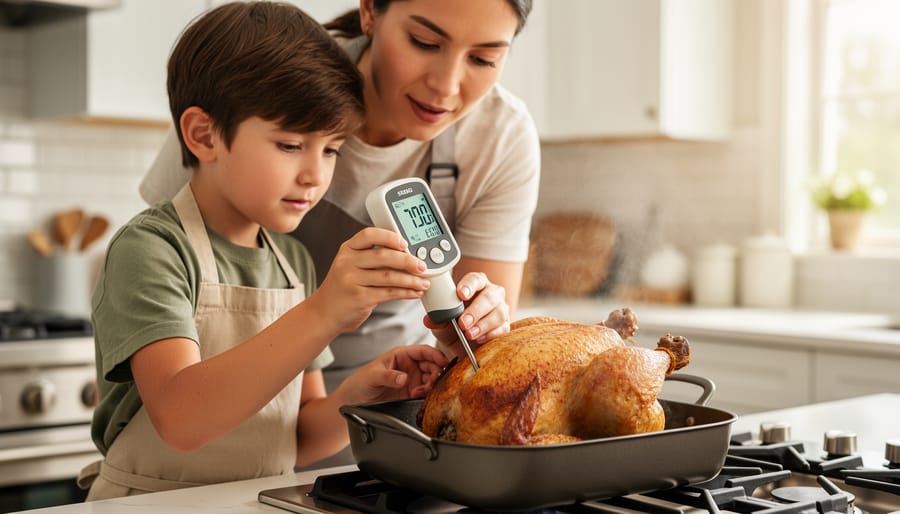
Transform the temperature check into a moment your kids actually look forward to. Try a “165 countdown” where everyone gathers around as the thermometer approaches the magic number, celebrating when it hits the target with a cheer or high-five. One family we know uses a small bell they ring each time chicken reaches the safe zone, turning it into an audible victory.
For younger children, create a simple chart where they place a sticker each time they help check or observe the cooking temp for chicken reaching 165°F. After five successful checks, they earn the privilege of choosing the next chicken recipe to prepare together. Older kids might enjoy keeping a “safe cooking journal” where they record temperatures and cooking times, building their confidence with each entry.
The key is consistency without pressure. Make it clear that checking temperature is simply what good cooks do, not a test they can fail. When temperature checks become woven into your family’s cooking rhythm, you’re building healthy habits that extend far beyond the kitchen. Your children learn that safety and celebration can coexist, and that doing things properly feels better than rushing through them.
Real Stories: When Families Get It Right
The Chen family’s breakthrough came during a weekend cooking session. Twelve-year-old Maya had always watched her mom prepare chicken stir-fry but never felt confident enough to try. Her mother started small, letting Maya hold the thermometer and call out the temperature readings. “165!” Maya announced proudly the first time she got it right. Three months later, Maya now prepares chicken independently, checking multiple spots in each piece and teaching her younger brother the same careful approach. Her mother notes that Maya’s newfound kitchen confidence has spilled over into other areas of her life.
At Roosevelt Elementary’s after-school program, coordinator James Martinez introduced thermometer training as part of their cooking club. He started with a simple challenge: every student would learn to check the cooking temp for chicken correctly before earning their “junior chef” badge. Eight-year-old twins Devon and Aaliyah treated it like a science experiment, competing to see who could identify the thickest part of each chicken piece faster. Within weeks, the entire group had mastered the 165°F checkpoint. Parents reported that their children now reminded them to check temperatures at home, transforming from students into teachers.
The Thompson household turned temperature checks into a weekly ritual. Every Sunday, one family member chooses a chicken recipe and leads the cooking, with everyone gathering for the thermometer reading. When ten-year-old Eli’s first attempt showed 158°F, he calmly returned the chicken to the heat and checked again five minutes later. His patience and precision impressed his parents, who realized their son had internalized not just the number but the responsibility behind it.
Common Questions Parents Ask About Chicken Cooking Temperatures
Parents want to do right by their children, especially when it comes to kitchen safety. Yet questions pop up constantly, sometimes before your child even picks up a spatula, sometimes mid-recipe when you’re second-guessing the thermometer reading. Here’s what parents and educators ask most often when teaching the 165°F standard.
“What if my child forgets to check the temperature?” This worry tops the list. Start with a simple habit: no thermometer check means the chicken isn’t done, period. Make it part of the sequence, just like washing hands before cooking. Put a sticky note on the oven or set a kitchen timer as a reminder until checking becomes automatic. Parents’ involvement at this stage builds the repetition that turns checking into muscle memory.
Is 165°F the same temperature everywhere?
Yes, 165°F is the safe minimum cooking temperature for all poultry in both the United States and Canada. This standard doesn’t change based on location.
How long does chicken need to stay at 165°F?
Chicken breast must reach 165°F for at least 15 seconds. Once it hits that temperature throughout, it’s safe to eat.
What thermometers are easiest for kids to read?
Digital instant-read thermometers with large displays work best for young cooks. Look for models that beep when they’ve finished measuring and show clear numbers without requiring interpretation.
Can my child tell if chicken is done without a thermometer?
No. Color and texture can’t reliably indicate safety, only a food thermometer can confirm proper cooking temperature.
Some parents wonder whether different chicken pieces need different temperatures. They don’t. Whether you’re cooking breasts, thighs, wings, or drumsticks, the internal temperature must reach 165°F. The thickness varies, so thicker pieces take longer to cook through, but the target temperature stays the same.
Another common question: “My thermometer gave different readings in different spots, which one is right?” When food is large or irregularly shaped, checking multiple places matters. The coolest reading is your answer because that’s the spot that took longest to cook. If one area reads 165°F but another reads 158°F, the chicken needs more time.
Parents also ask about thermometer placement. Insert it into the thickest part of the meat, steering clear of bone, fat, or gristle, which can throw off the reading. For thin cutlets, slide the thermometer in through the side until it reaches the center rather than poking down from the top.
Teaching safe cooking temperatures connects naturally to broader health lessons. Just as kid nutrition tips help families make better food choices, temperature education gives children the tools to prepare those nutritious meals safely. The questions you’re asking now show you’re taking this teaching moment seriously, and that’s exactly the approach that builds confident, capable young cooks.
Building Lifelong Kitchen Safety Habits Beyond Temperature
Mastering the proper cooking temp for chicken becomes a gateway lesson that transforms how children think about kitchen safety. Once your child understands why 165°F matters, they’re ready to grasp the interconnected web of practices that keep everyone healthy. The thermometer becomes their first tool in a larger toolkit of lifelong food safety habits.
Start connecting the dots for your kids. If bacteria on raw chicken are invisible but dangerous, then washing hands after touching the package makes perfect sense. If cross-contamination can transfer those bacteria to cutting boards and counters, then having separate boards for raw meat and vegetables becomes logical rather than arbitrary. Children who learn the “why” behind one safety rule naturally become more receptive to others.
Hand hygiene pairs beautifully with temperature checks. Make handwashing the bookends of your cooking sessions: scrub before starting and immediately after handling raw chicken, then again after checking the temperature. Many families create a simple routine where kids say aloud what they’re doing, reinforcing the habit through repetition.
Cross-contamination prevention offers another hands-on teaching opportunity. Show children how raw chicken juice can spread, then demonstrate proper cleanup with soap and hot water. Let them help sanitize surfaces under supervision. They’ll remember these lessons far better than any lecture because they’re actively participating.
Storage habits matter too. Teach kids that raw chicken lives on the bottom refrigerator shelf where it can’t drip onto other foods. Show them how leftovers should cool quickly and get refrigerated within two hours. These practices, learned young, stick.
The beauty of starting with something concrete like cooking temperature is that it builds momentum. Each new safety skill reinforces the others, creating confident young cooks who understand that kitchen safety isn’t about fear but about respect for the food and the people you’re feeding.
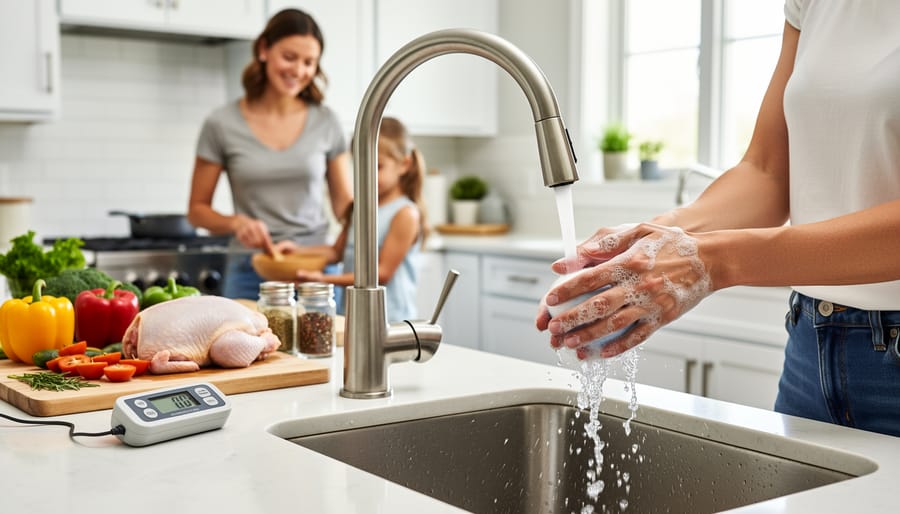
Remember that first nervous moment when you handed your child the thermometer and watched them check if dinner was ready? That small act of trust, guided by the simple rule that chicken reaches 165°F, plants seeds that grow far beyond tonight’s meal. You’re not just teaching a temperature. You’re showing your child that they can learn to keep themselves and others safe, that precision matters, and that they’re capable of real responsibility in the kitchen.
Start where you are. Maybe today your five-year-old just watches you insert the thermometer. Next month, your eight-year-old reads the numbers aloud. By next year, they’re confidently checking multiple spots in a chicken breast, proud of their mastery. Each small success deserves celebration because you’re building something lasting: a young person who knows that caring for others begins with simple, consistent actions like verifying that cooking temp for chicken.
The families and educators who make food safety part of their daily rhythm, rather than an occasional lecture, find that children absorb these lessons naturally. They grow into teenagers and adults who cook with confidence because someone took the time to teach them right.